If your cat has been in and out of the litter box tonight with little or nothing to show for it, do not give it until morning to sort itself out. Whether this is an emergency depends less on the cause and more on the urine output, so little or no urine after repeated tries, crying in the box, a tense or painful belly, or going quiet and stopping eating all mean your cat needs to be seen today. In male cats especially, the narrow tube that carries urine out can plug with crystals and inflammatory debris, and once nothing is passing at all, the situation turns life-threatening inside of a day. Milder cases still need attention, because feline lower urinary tract disease also covers bladder inflammation, stones, infection, and the stress-driven cystitis that keeps a cat returning to the box every few minutes and can become an emergency blockage overnight.
Watching your cat try again and again with nothing happening is frightening, and the hardest part is not knowing how much time you have. State of the Heart Veterinary Care in Denver keeps urgent and same-day appointments open for a cat who cannot pee. A sick exam with us combines hands-on evaluation with in-house diagnostics, so you find out quickly whether this is a blockage or something we can treat and manage at home. If we are closed when this happens, go straight to the nearest 24-hour veterinary ER instead of waiting for us to open, and otherwise give us a call and we will find your cat a spot today.
Four Things to Know Tonight if Your Cat Keeps Straining
- FLUTD is a label for a cluster of bladder and urethra problems, not one disease, and from outside the litter box they all look the same.
- Repeated straining with nothing coming out, above all in a male cat, points to a possible blockage, and that needs a vet today rather than tomorrow.
- Stress-driven bladder inflammation sits behind most episodes, and the home setup ends up mattering as much as anything we prescribe.
- One episode raises the odds of another, and modest changes to water, litter boxes, and daily routine bring those odds back down.
Why Does My Cat Keep Running to the Litter Box With Nothing to Show for It?
Feline lower urinary tract disease is the label we use for a cluster of bladder and urethra problems rather than the name of a single disease, and it turns up most often in middle-aged, indoor, overweight cats. Whatever's driving a given case, the bladder wall swells and the nerves inside it fire nonstop. Your cat feels the urge every few minutes with almost nothing there and keeps returning to the one spot that's supposed to bring relief.
Risk isn't spread evenly. The cats we see most live entirely indoors, carry extra weight, share the house with other cats, or eat nothing but dry food. Male cats get their own mention because the urethra narrows toward the tip, and that's exactly where a plug lodges. Still, any cat of any age can develop urinary disease, and a first episode often arrives without warning.
The outward signs look nearly identical whatever the cause. A same-day sick appointment is what separates a cat who needs a diet change from a cat who needs a catheter.
What Causes FLUTD, and Why Does Stress Set It Off?
By a wide margin, the most common cause is feline idiopathic cystitis. That's inflammation of the bladder wall with no bacteria and no stone to explain it, and a stressor is the usual trigger for a flare. Stones, urethral plugs, and less often infection account for the rest, and more than one can be in play at once.
Under stress hormones, the protective layer lining the bladder thins out, and urine starts irritating the tissue beneath it. A new baby, construction next door, a roommate moving out, or a shifted feeding schedule can each land a day or two before a flare.
Each cause pulls treatment in a different direction.
| What's behind it | What goes wrong | Who tends to get it | How we usually handle it |
| Urethral plug | Crystals, mucus, and cellular debris pack together and block the urethra | Male cats, whose urethra pinches down near the tip | An emergency catheter and a hospital stay |
| Idiopathic cystitis | The bladder wall inflames with no stone or bacteria to blame | Younger to middle-aged indoor cats who take stress hard | Pain control, extra moisture, a calmer household |
| Calcium oxalate stones | Dense stones no diet can break down | Older cats, and Persians and Burmese in particular | Surgical removal followed by a prevention plan |
| Struvite stones | Minerals precipitate out of alkaline urine | Adult cats, often fed kibble alone | A dissolution diet fed for several weeks |
| Bacterial infection | Bacteria take hold in the bladder itself | Cats over ten, usually with another illness on board | Antibiotics matched to a culture result |
| Less common causes | Tumors, strictures, structural defects, or trauma | Any age, though seniors more often | Imaging to find the answer, then a plan built for that case |
The type of stone dictates the route. Struvite urinary stones will often dissolve on a prescription diet; calcium oxalate stones have to come out. In some cases we’ll recommend surgically removing struvite stones anyway, especially if they are large or numerous, to prevent blockage.
Plugs are a category of their own. Rather than true stones, they're a soft, gritty paste of crystals, mucus, and inflammatory debris that forms inside a bladder that's already irritated. The idiopathic flare that has a male cat straining today can produce the debris that blocks him two days later.
Which Litter Box Signs Mean My Cat Needs to Be Seen Today?
Frequent trips that yield a few drops, visible straining, pink or bloody urine, crying in the box, and licking at the genital area all warrant a same-day look. Add urinating outside the box to that list, since a cat who has come to associate the box with pain often picks a sink or a pile of laundry instead. Straining can also be constipation rather than urine trouble, and the two are indistinguishable from across the room. That's one more reason to have your cat checked instead of guessing.
A few signs mean the visit can't wait:
- Nothing coming out: Repeated attempts with no urine, above all in a male cat, can mean a full bladder that can't empty.
- Crying or howling: Yowling in or beside the box is pain talking, not attitude.
- Vomiting or turning away from food: Once waste backs up behind an obstruction, nausea follows fast.
- A tense, painful belly: A bladder that feels firm and grapefruit-tight is an emergency finding.
- Hiding, weakness, or a cool body: A cat who has gone silent and won't move is further along than one who's still yowling.
While you're deciding, three things stay off the table:
- Human pain relievers. Ibuprofen, naproxen, and acetaminophen are all poisonous to cats, and the dose that turns deadly is tiny.
- Over-the-counter enemas. The phosphate products sold for people are toxic to cats.
- Pressing on the belly. Squeezing to move urine along can rupture an overfull bladder.
Not sure which group your cat is in? Call and describe what you're seeing. We'll tell you whether to come in now or take a slot later in the day.
How Do We Tell One Urinary Problem From Another?
Urinalysis comes first. One sample tells us the pH, how concentrated the urine is, and whether crystals, blood, or white cells are present. Bloodwork, a culture, and imaging fill in what that sample can't.
Because our in-house lab runs both urinalysis and blood panels on site, we're not waiting on a courier when a decision can't wait. Kidney values and potassium show what an obstruction has already cost, and in an older cat the same panel can turn up diabetes or hyperthyroidism hiding beneath the bladder signs.
A bacterial urinary tract infection is uncommon in cats under ten and far more likely in older cats living with kidney disease, diabetes, or hyperthyroidism. A urine culture settles whether antibiotics belong in the plan at all.
Digital X-rays pick up most bladder and urethral stones and show us how large and distended the bladder is. An abdominal ultrasound, scheduled with the imaging specialist who visits our practice, catches the stones or bladder tumors that radiographs miss, measures how thick the bladder wall has become, and looks at the kidneys for trouble higher up the tract.
What Happens If My Cat Is Blocked?
A cat who can't pass any urine has a urethral obstruction until proven otherwise. The potassium and kidney changes that follow can become life-threatening within a day or two. Care begins with pain control and sedation, then a urinary catheter to drain the bladder and IV fluids to protect the kidneys.
We hold room for same-day urgent care, and a cat who can't urinate goes to the front of that line. Rising potassium slows the heartbeat and can stop it altogether, and that rhythm change is what turns an obstruction deadly this fast. Our in-house blood panel tells us how high the potassium has climbed; tracking what it's doing to the rhythm on an EKG is part of the hospitalized care that follows.
Clearing the blockage is only the first half. The second half is a day or two with the catheter in, fluids running continuously, and someone tracking urine output through the night, and that requires overnight staffing. We stabilize your cat here and coordinate transfer to a 24-hour hospital for the hospitalized portion, then pick the rechecks back up once they're home. If this happens on a Sunday or in the middle of the night, go straight to the emergency hospital.
Re-blocking is most likely in the first week after discharge. Plan on at least one recheck, and keep an eye on the box for several days.
What Does Treatment Look Like Once We Know the Cause?
Most cats leave with a plan rather than one prescription. Bladder spasm relief, a diet change when crystals or stones are involved, and adjustments at home usually travel together. We build the combination around what the workup showed and what's realistic in your house.
| Tool | When it comes into play | What it looks like for your cat |
| Catheterization | A blocked cat, treated as an emergency | Sedation, a catheter left in for a day or two, fluids, and close monitoring |
| Pain and spasm control | Almost every case, since an inflamed bladder hurts | A short course of buprenorphine, gabapentin, or a medication that relaxes the urethral muscle |
| Antibiotics | Only after a culture grows bacteria | A targeted course, with a repeat sample when it matters |
| Therapeutic urinary diet | Crystals, struvite stones, or flares that keep coming back | Usually a canned formula, and it has to be fed exclusively to work |
| Surgery | Cats who block again and again, or stones too big to dissolve | A hospital stay, an e-collar, paper litter, and a recovery of about two weeks |
| Stress and environment plan | Idiopathic cystitis, and any home with more than one cat | Litter box changes, water stations, play, sometimes anxiety medication |
For a cat who keeps blocking, perineal urethrostomy bypasses the narrowest segment of the urethra with a wider opening, and plugs lose the place they used to lodge. It prevents obstruction; it does not cure the inflammation underneath. We perform a large range of complex and routine soft tissue surgery here, and we’ll let you know if we recommend that your cat’s surgery be performed with a specialist instead.
How Do I Keep This From Happening Again?
Idiopathic cystitis has a habit of coming back, and the strongest levers live at home rather than in a pill bottle.
Lowering the Stress That Sets Off a Flare
Cats pick up on household stressors that people barely register: a shifted work schedule, a houseguest, or quiet friction with another cat over a shared box.
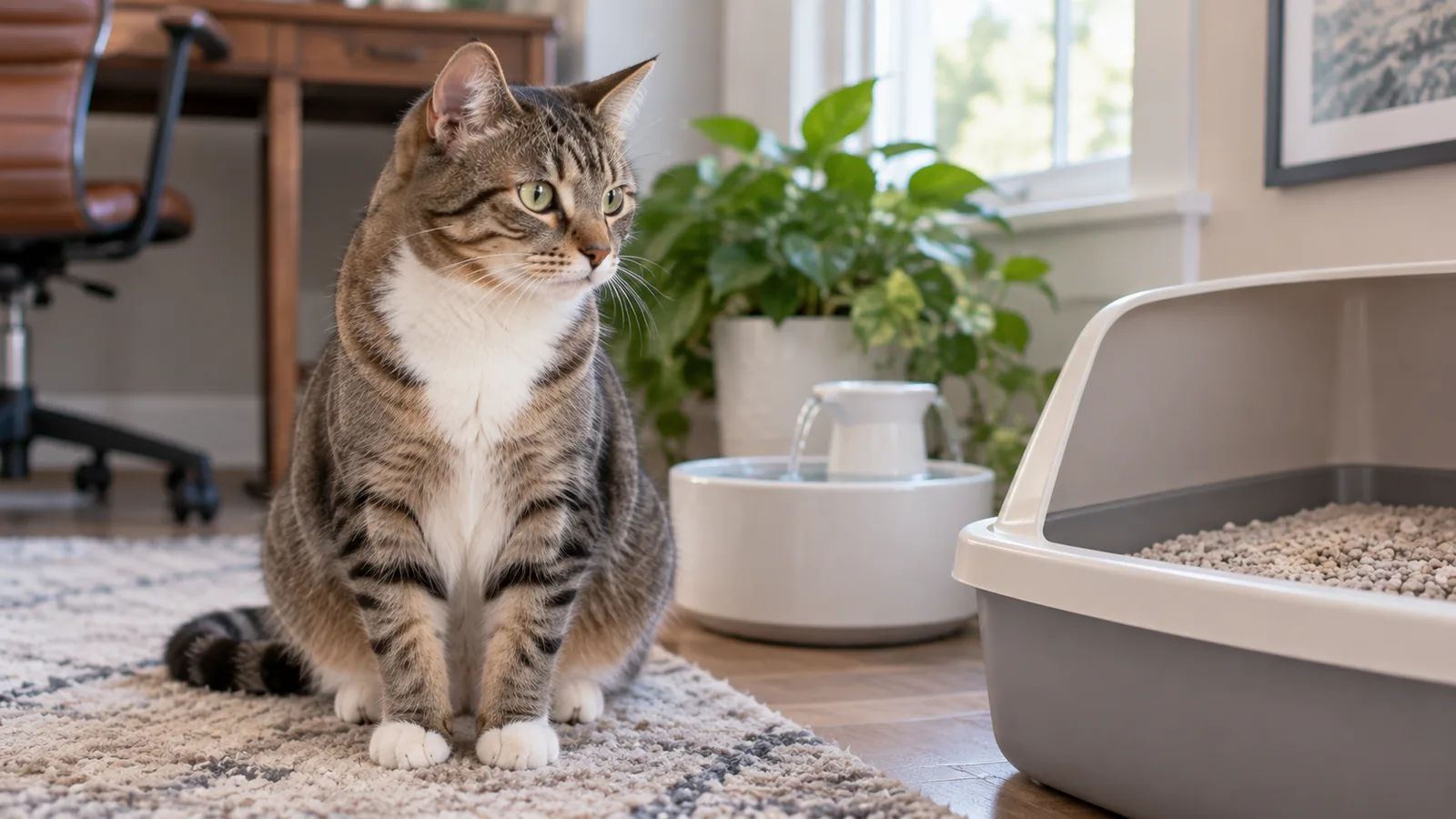
Start with the box count. The rule is one box per cat plus a spare, which means two cats need three boxes, each in its own quiet spot, uncovered, and scooped every day. Keep them out of the laundry room, where a washer hitting its spin cycle can send a cat bolting mid-squat. Vertical space earns its keep too. A cat who can climb above the action opts out of a conflict without leaving the room.
Enrichment doesn't take a shopping trip, because homemade toys built from paper bags, cardboard tubes, and egg cartons give a cat the hunt-and-catch outlet that works off the tension feeding a flare.
When anxiety runs high, behavioral medicine gives us options beyond rearranging furniture, and that conversation is worth having before the next episode rather than after it.
Food and Water Choices That Keep Urine Dilute
For a urinary cat, the wet food versus dry food debate has a clear winner. Canned food runs roughly 70 to 80 percent water. Kibble comes in at about 10 percent. That gap shows up directly in the litter box as more dilute urine, which gives crystals less chance to form and rinses the bladder more often.
If kibble is all your cat has ever known, go slowly. Mix a spoonful of canned into the familiar food and increase the share over a week or two. A cat who stops eating altogether can develop liver trouble fast, and a stubborn hunger strike is worse than a slow transition.
Most cats drink more from wide, shallow bowls placed away from the food, and plenty prefer a fountain's moving water. Extra pounds raise urinary risk all by themselves. A weight and body condition check at each visit gives us a real number to work from.
Why Rechecks Matter After a Urinary Episode
After one episode, a periodic urinalysis is worth doing even when everything looks fine at home, because crystals and small stones form without any outward sign. Twice-yearly exams as a cat ages also catch the kidney and thyroid disease that complicates bladder trouble, and preventive care visits are where we follow those changes over time.
If the old pattern shows up again, come in sooner rather than later. An early visit is nearly always shorter, simpler, and less expensive than an emergency one.
Cat Urinary Questions Pet Families Ask Us Most
Is a blockage only a male cat problem, or can my female cat block too?
Short answer: she can, though it's rare. Female cats develop FLUTD about as often as males, with the same straining, blood, and constant trips. What differs is anatomy. A female's urethra is wider and shorter, and the crystals and debris that would wedge in a male usually pass straight through. Rare isn't never, though. A female cat producing nothing after repeated attempts needs the same urgent evaluation, and stones, infection, and idiopathic cystitis turn up in both sexes.
Why is my cat suddenly peeing on the bath mat instead of in the box?
Picture it from the cat's side: the last three trips to the box hurt, and the box is the thing that gets blamed. Soft, absorbent surfaces like bath mats, laundry, and bedding are the usual substitutes. Treat a sudden change like this as medical until a urine sample proves otherwise. An extra box and a thorough cleanup may fix a truly behavioral case, but neither touches inflammation or a stone. Testing sorts it out fast, and if the sample comes back clean, we move to the behavioral side with real information in hand.
Can I treat a mild urinary episode at home?
The risk is in the waiting. For the first several hours, a mild flare and an early obstruction look identical from across the room. Cranberry supplements, extra water bowls, and over-the-counter urinary products won't dissolve a stone, ease pain, or open a blocked urethra. Home changes matter enormously between episodes and make up most of the long-term plan. During an episode, a cat straining in the box needs an exam and a urine sample before anything else.
Getting Your Cat Through a Urinary Episode
Most cats come through an episode and settle back into ordinary life with a handful of changes at home. State of the Heart Veterinary Care in Denver sees these cases regularly, and we'll tell you what the urinalysis showed, what we think is behind it, and what we'd do next if this were our own cat.
Cats with a urinary history do better with routine rechecks on the calendar than with waiting for the next flare. If something looks off today, request an appointment and we'll get your cat on the schedule.